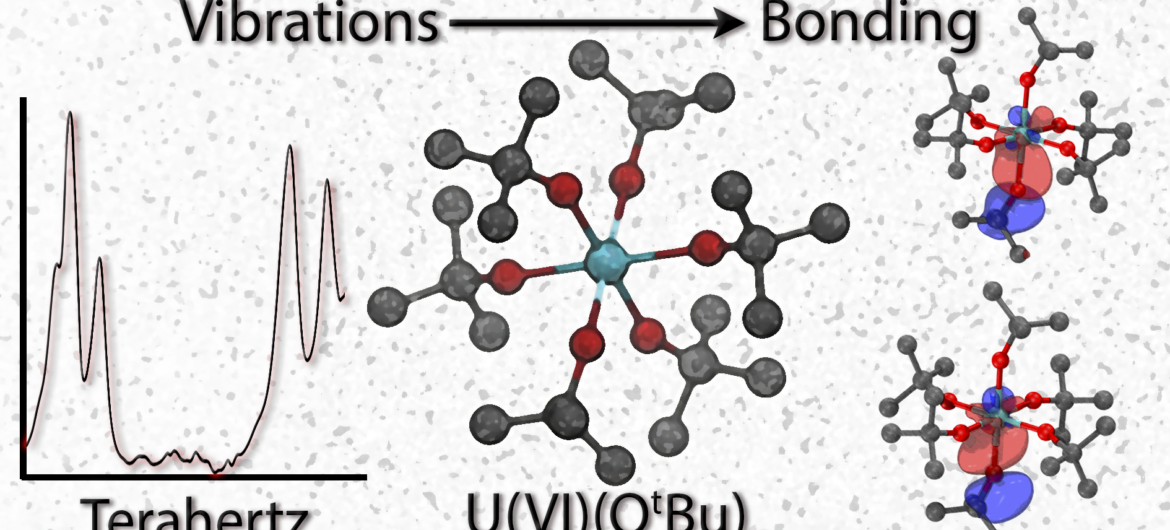
Our new work, “Terahertz dynamics at the actinide frontier: linking low-frequency vibrations, electronic structure, and bonding in molecular uranium complexes” was just published in Chemical Science. A big thank you to our fantastic collaborators in the Matson group for another successful joint effort.
In this paper, we apply low-frequency vibrational spectroscopy to study the nature of metal-ligand bonding in crystalline actinide complexes. Understanding these interactions is crucial for nuclear waste remediation techniques but is notoriously difficult to capture with traditional techniques. For example, advanced techniques like X-ray absorption (XAS) require access to specialized user facilities like synchrotrons, while powerful methods like NMR can struggle to extract clear bondingmetrics in open-shell, paramagnetic systems.
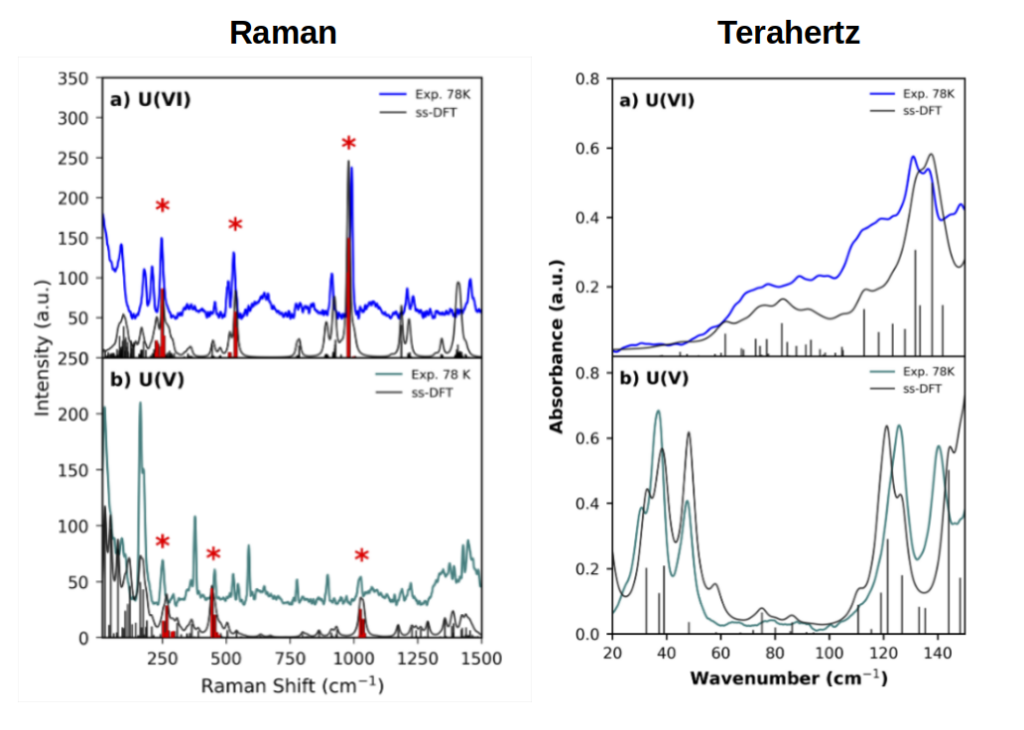
While systems containing the linear uranyl ion ([UO2]2+ have been well characterized using vibrational spectroscopy, non-uranyl complexes with bulky, flexible organic ligands exhibit highly complex vibrational signatures, especially in the low-frequency region, which have historically remained not characterized. By combining low-frequency experimental measurements with solid-state DFT simulations, we were able to extract bonding information hidden in these complex spectra.
Specifically, we focused on the vibrations below 500 cm-1. Because uranium is particularly heavy and single U-O bonds are relatively weak, relevant vibrations carrying bonding information are pushed to the low-frequency region. Here, the core uranium-ligand motions mix heavily with the collective movements of the surrounding organic ligands (the tert-butyl groups).
Using Local Mode Analysis (LMA), we were able to get rid of this mixing and extract local information about the uranium-oxygen (U-O) bonds, isolating the “pure” intrinsic stretching force constant of the U-O bond. With this metric, we quantitatively proved that reducing the uranium center from U(VI) to U(V) causes a distinct drop in the U-O stretching force constant, providing an experimentally-anchored confirmation of bond weakening.
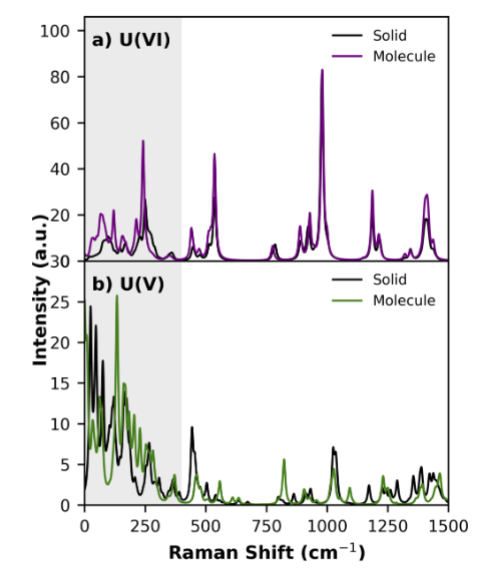
In addition, we focused on the role of the solid-state environment in these two systems. In the neutral, closed-shell U(VI) alkoxide complex, the bulky tert-butyl groups act as a steric shield, protecting the electronic structure of the U-O core from the surrounding crystal environment. This indicated that its bonds can be described by isolated molecule models. In contrast, the electronic structure of the ionic, open-shell U(V) crystal is strongly influenced by its crystalline environment, especially by the presence of the counterion in the lattice.
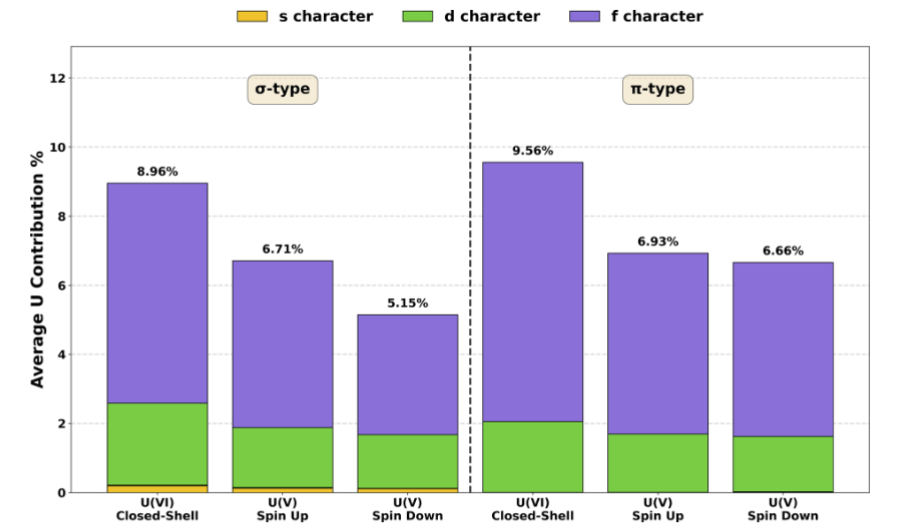
Finally, by using complementary topological and orbital analyses (quantum theory of atoms in molecules (QTAIM) and natural bond orbital (NBO) analysis), we were able to connect our vibrational force constants with quantum mechanical electron density properties. This analysis revealed that the U-O bonding is dominated by uranium 5f orbitals, which have a favorable energy matching with the oxygen ligand 2p orbitals.
Overall, this work establishes a computationally validated and experimentally anchored framework to probe changes in bond strength and crystal packing for heavy-element complexes. This methodology opens up new pathways to interpret the electronic structure, and the properties deriving from it, of other heavy-element systems.


